

Why are my tyres wearing unevenly?
Uneven tyre wear is a message: the pattern on the tread usually tells you whether pressure, alignment or a worn suspension part is behind it.
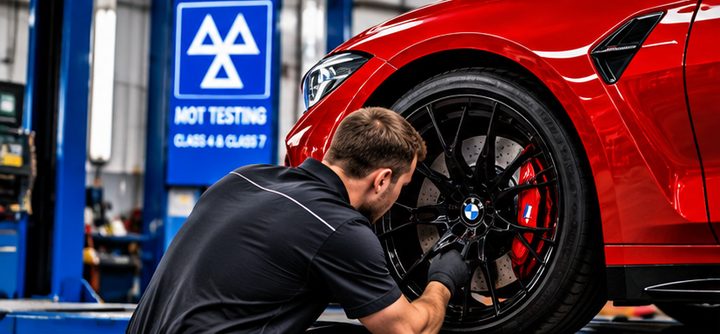
Tyres wearing unevenly is most often caused by incorrect pressure, wheel alignment that has drifted out of line, or tired suspension parts that let the tyre bounce or lean. Where the wear sits on the tread, and which tyre it is on, points you towards the cause.
The good news is that you can read much of the pattern yourself with a torch and a few minutes. At Automaster, a garage at Longcombe Cross near Totnes, we see the same patterns repeatedly, and this guide explains what each one usually means and what to do next.
What does it mean if the inside or outside edge of a tyre is worn?
Wear concentrated on one shoulder, usually the inner edge, commonly points to alignment. If the wheels are not pointing exactly where the manufacturer intended, part of the tread is dragged across the road instead of rolling. Camber and toe settings are the usual suspects.
Alignment can be knocked out by a hard kerb strike, a deep pothole, or worn steering and suspension joints that allow the wheel to move more than it should. Narrow lanes with rough edges and hidden potholes make this easy to do without noticing.
- Inner shoulder worn more than the rest: check alignment and suspension joints
- Outer shoulder worn on the front tyres: often hard cornering combined with alignment
- One tyre only affected: look for a damaged or worn part on that corner
- A steering wheel that sits off-centre on a straight road is a further clue
Why is the middle or both edges of my tyre wearing faster?
A tread worn mainly down the centre suggests the tyre has been run over-inflated, so the middle bulges and takes most of the load. Wear on both shoulders with a better-looking centre suggests the opposite: under-inflation, where the sides carry the weight.
Pressure is the simplest and quickest thing to check, and it should be checked cold, using the figures in your handbook or on the label usually found in the door frame or fuel flap. Remember that figures can differ between front and rear and between normal and fully laden use.
What causes patchy, scalloped or feathered tyre wear?
If the tread has a wavy, scooped feel, sometimes called cupping, run your hand gently around the tyre and you may feel high and low spots. This often indicates a worn shock absorber, a weak spring or a loose joint, because the tyre is bouncing rather than staying planted. An out-of-balance wheel can contribute too.
Feathering, where the tread blocks are smooth one way and sharp the other, is generally linked to toe alignment. Running a hand across the tread from inside to outside will reveal it. A flat spot or a single worn patch can also follow heavy braking, which is a different matter from a steady pattern.
Is it safe to drive on unevenly worn tyres?
The legal minimum tread depth for cars in the UK is 1.6 mm across the central three quarters of the tread and around the whole circumference. Uneven wear can take one part of a tyre to that limit long before the rest looks worn, so check the shoulders and not only the middle.
Stop driving and get the car looked at promptly if you can see cord or the inner structure showing through, if there is a bulge, if the car pulls hard to one side, or if there is a new vibration or knocking from a wheel. Those signs mean the problem is no longer just cosmetic.
What will a garage do about uneven tyre wear?
A proper inspection looks at the tyres first, then at what is likely to have caused the pattern: pressures, balance, steering and suspension joints, shock absorbers and the alignment readings. Fitting new tyres without finding the cause tends to repeat the problem, so the cause matters as much as the tyre.
What it takes depends on the vehicle, on how many tyres are affected, and on whether worn parts need replacing as well as the alignment being set. We can only say what is needed after the car has been inspected, so we would rather look than guess.
Uneven wear is easier and cheaper to deal with when it is caught early. Ask Automaster for a quote and we will inspect the tyres and the parts around them before recommending anything.
Common questions
Can I fix uneven wear by rotating my tyres?
Rotating may even out future wear on some cars, but it does not cure the cause. If alignment or a worn part is behind the pattern, the new position will wear unevenly too. It is better to find the cause first.
How often should I check my tyres for wear?
A quick look every few weeks, and before a long journey, is sensible. Check the pressures at the same time and look at the inner shoulders, which are easy to miss from the driver's side.
Will wheel alignment stop my tyres wearing unevenly?
It can, provided alignment is the cause. If worn joints or shock absorbers are involved, those usually need attention first or the alignment will not hold for long.
Does uneven wear cause an MOT failure?
The MOT looks at tread depth, condition and damage, so a tyre worn below the legal limit in any part of the tread can fail. Cord showing is also a failure.
More advice
Ask for a quote
Tell us the make, model, registration and what the car is doing, and we will come back to you. Prefer to talk? Call our quote line on 01803 862152.
Automaster, Longcombe Cross, Longcombe, Totnes TQ9 6PL, United Kingdom