

When can a puncture be repaired?
A puncture in the main tread area can often be repaired properly, but damage to the sidewall or edge of the tread normally means a new tyre.
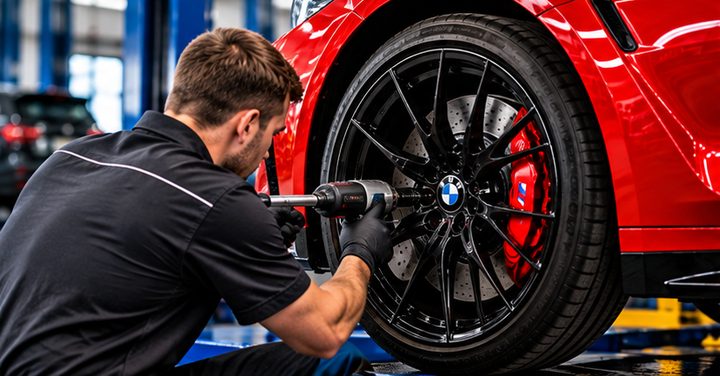
Whether a puncture can be repaired depends on where the hole is, how big it is, what caused it and how far the tyre was driven while flat. Only a proper inspection with the tyre off the wheel can settle it.
The general rule in the UK is that a repair is acceptable only in the central part of the tread, and never in the sidewall or the shoulder. A quick plug pushed in from outside, with the tyre left on the car, is not considered a proper repair.
Where on the tyre can a puncture be repaired?
The repairable zone is the central three-quarters of the tread, the same area the legal tread depth rule covers. Nails and screws that go into the middle of the tread are the classic case that can be fixed.
The sidewall flexes constantly as the tyre rolls, so a patch there cannot be trusted to hold. The same goes for the shoulder, the curved edge between the tread and the sidewall. A puncture in either area normally means replacement.
Tell the garage if you know how the puncture happened. A nail picked up on a driveway is a different story from a tyre that has hit a sharp edge at speed, because the second may have hidden internal damage.
How is a puncture repaired properly?
The wheel comes off the car and the tyre is removed from the rim so the inside can be examined. A proper repair fills the hole and seals the inner liner, usually with a combined plug and patch fitted from the inside, then the tyre is refitted and the wheel balanced.
Sealing the hole from the outside only, or patching without checking the inside, leaves hidden damage unchecked. That is why a roadside plug is better treated as a short-term measure to get you home.
- Tyre removed from the wheel for inspection
- Hole cleaned, filled and sealed from the inside
- Wheel refitted, inflated and balanced
- Tyre pressure checked once fitted
Why can't every puncture be repaired?
Size matters, and so does the number and position of previous repairs. A large hole, a tear or a puncture too close to an earlier repair can mean the tyre is not suitable for another one.
Driving on a flat tyre is the other common reason. Even a short distance can damage the inner sidewall, and that damage may not be visible from the outside. Some tyre types and speed ratings also have their own limits, so check your handbook and ask your fitter about your own tyres.
What should I do if I get a puncture?
Pull over somewhere safe, switch on your hazards and avoid driving further than you need to. Check whether your car carries a spare, a repair kit or a sealant, and read the handbook for how to use it, because arrangements differ between vehicles.
Sealant is meant as a temporary measure. Tell the garage you have used it, because it affects how the tyre is handled and whether it can be repaired afterwards. Also keep an eye on the pressure of the other tyres, since a slow leak is easy to miss until the tyre is soft.
When should I stop driving and replace the tyre?
Stop if the tyre is flat, shredded or visibly damaged, or if the car is pulling or feeling unstable. Do not carry on in the hope of reaching home, as damage worsens quickly and can affect steering control.
Automaster is a garage at Longcombe Cross near Totnes. Bring the car in and we will inspect the tyre, tell you whether a repair is possible or replacement is needed, and give you a quote. The cost depends on the tyre size and type, and on whether a repair is suitable.
A tread puncture may be repairable, but sidewall or edge damage is not. Ask us for a tyre inspection and quote and we will tell you what is possible.
Common questions
Can a sidewall puncture be repaired?
No. The sidewall flexes too much for a repair to be reliable, so the tyre normally needs replacing.
Is a plug from the outside a proper repair?
Not on its own. A proper repair is made from the inside with the tyre off the wheel, so that the inner liner can be inspected and sealed.
Can run-flat tyres be repaired?
It depends on the manufacturer's guidance and how the tyre was used. Check your handbook, and ask the garage before assuming either way.
How many times can one tyre be repaired?
It depends on the position, size and spacing of the damage. Each case is judged on inspection, so there is no fixed number to rely on.
More advice
Ask for a quote
Tell us the make, model, registration and what the car is doing, and we will come back to you. Prefer to talk? Call our quote line on 01803 862152.
Automaster, Longcombe Cross, Longcombe, Totnes TQ9 6PL, United Kingdom