

What does a failing wheel bearing sound like?
A failing wheel bearing typically hums, growls or roars, gets louder as speed rises, and often changes when you steer left or right.
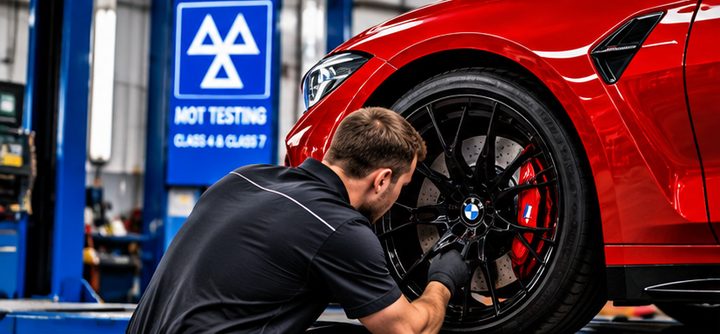
A failing wheel bearing normally makes a steady hum or growl that rises with road speed, and it is often described as sounding like a distant aircraft or an aggressive off-road tyre. It sits at the wheel hub and is felt through the floor and sometimes the steering wheel.
One useful clue is that the noise changes when you load the car sideways. If it gets louder when you steer gently one way and quieter the other way, the bearing on the loaded side may be the problem. That clue is not conclusive, but it is more helpful than the sound alone.
What are the symptoms of a bad wheel bearing?
Symptoms start gently and worsen as the bearing wears. The sound often begins at moderate speeds and moves down the speed range as it deteriorates.
- A humming or roaring that rises with speed, not with engine revs.
- Noise that changes in long bends or with gentle steering left and right.
- Vibration through the floor or steering wheel.
- A rumble that stays the same when you press the clutch or shift gear.
- In later stages, a grinding sound, a loose-feeling wheel or an ABS warning light, depending on the vehicle.
Could it be tyre noise instead?
Yes, and it happens often. Tyres with uneven or cupped wear, harsh road surfaces and some tread patterns can sound very like a bearing. Noise from a tyre often changes with the road surface, while a bearing hum usually stays similar on smooth and rough surfaces.
Check your tyre pressures and look for uneven wear. Remember the legal minimum tread depth is 1.6 mm. A garage can compare tyres and bearings and tell the two apart, and it is worth mentioning any recent tyre changes when you ask for a quote, because a new set can change the sound completely.
How can I check a wheel bearing safely?
The reliable check involves lifting the wheel off the ground, holding it at the top and bottom, and feeling for movement, then spinning it by hand to listen and feel for roughness. Do this on a proper lift or axle stands, not with a jack alone.
At home, the safest checks are listening on a quiet road, noting how the sound changes with speed and steering, and writing down which side seems loudest. Noise can be unreliable about which side it comes from, so treat it as a hint.
What does a garage do about a noisy wheel bearing?
A garage will check for play and roughness, inspect the hub, driveshaft nut and brakes, and may compare left and right. Bearings are often replaced as a hub assembly or a pressed-in bearing, depending on the vehicle.
Cost drivers include the type of bearing, how difficult it is to remove, whether ABS sensor parts are involved, and whether other worn parts are found. We cannot say what a particular car needs before it has been looked at.
When should I stop driving?
A bearing that is loud, grinding, getting hot or causing vibration should not be driven on for long. In extreme cases a bearing can seize, and the wheel could be affected.
If the hum is mild you may be able to drive carefully to a garage, but do not delay, avoid long motorway journeys, and stop if the noise suddenly worsens or the steering feels odd.
Hum that rises with speed is worth taking seriously, because a bearing can only get worse. Automaster is a garage at Longcombe Cross near Totnes, so ask for a quote and tell us how the sound changes.
Common questions
Can I drive with a humming wheel bearing?
It is not wise for long. The wear usually worsens, so arrange an inspection promptly.
Will a wheel bearing fail the MOT?
Excessive play or roughness in a wheel bearing can lead to a fail or advisory, depending on the severity.
Do I replace bearings in pairs?
Not always. It depends on the vehicle and what the inspection shows, and a garage can advise. Both sides may have covered similar mileage, so a second bearing is sometimes close behind the first.
Does the clutch pedal change the noise?
Pressing the clutch in does not usually change a bearing noise, while engine or gearbox noises often change. Likewise, a bearing hum follows road speed rather than engine speed in any gear. This is a useful clue only.
More advice
Ask for a quote
Tell us the make, model, registration and what the car is doing, and we will come back to you. Prefer to talk? Call our quote line on 01803 862152.
Automaster, Longcombe Cross, Longcombe, Totnes TQ9 6PL, United Kingdom