

Warped or worn brake discs: what are the symptoms?
A pulsing pedal, a shaking steering wheel or a rough edge on the disc point to worn or uneven brake discs rather than a fault with the pads alone.
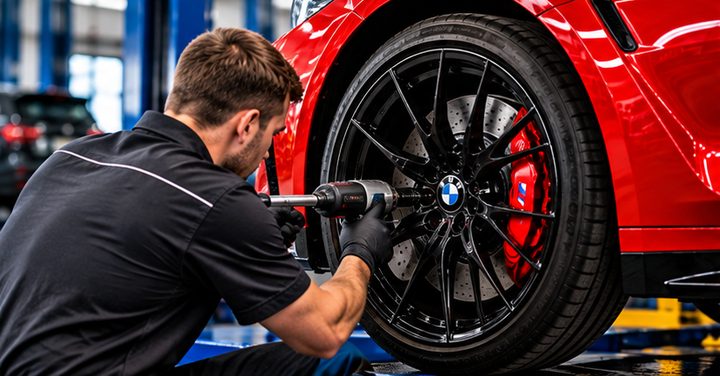
If the steering wheel shudders or the pedal pulses under your foot whenever you brake from speed, the discs are the first thing to suspect. People often call this warped discs. In practice the disc is usually wearing unevenly or has uneven deposits on its surface, and the result feels much the same.
Discs are the steel rotors that the pads grip to slow each wheel. They wear a little every time you brake, and they can be damaged by heat, rust, seized parts and worn pads left too long. Here is how to tell the symptoms apart, what you can safely look at, and what a garage will do.
Why does my steering wheel shake when I brake?
Shaking through the steering wheel when braking, especially from higher speeds, normally points to the front discs. The thickness of the disc varies slightly around its circumference, so the pads grab and release as the wheel turns. You feel that as a vibration or judder.
A pulsing brake pedal tells a similar story. If the vibration is mainly in the seat or the floor, the rear discs may be involved. Wheel balance or worn suspension parts can also cause shaking, but those usually appear while driving, not only when the brakes are applied.
What does a worn brake disc look like?
A healthy disc has a smooth, evenly polished face. A worn one shows its age. Look through the wheel, or with the wheel removed, for these signs on a parked, cool car.
Rust on the face is normal after the car sits, and it should wear off after a few stops. Deep rust, a pitted surface or flaking that does not clear is different.
- A raised lip around the outer edge of the disc
- Deep grooves or scoring you can feel with a fingernail
- Blue or dark patches that suggest overheating
- Cracks, especially running outwards from the edge or the holes
- A disc that looks visibly thinner than a newer one
Can I check disc condition at home?
You can look, but a proper check needs measuring. Every disc has a minimum thickness, often marked on the disc itself or listed in the manufacturer data, and a garage uses a micrometer to compare the actual thickness against it. The disc is also checked for run-out, which is wobble as it turns, and for variations across the surface.
A visual look from outside cannot show the inner face. If you notice a lip, deep scoring, vibration or any pull to one side, arrange an inspection rather than relying on a quick glance.
What causes brake discs to wear out or distort?
Normal wear is the main cause, and the pads and discs wear together. Heavy braking from speed, long descents, loaded driving and stop-start traffic all add heat and wear. Seized caliper slides or a sticking caliper can keep a pad pressed on the disc, creating hot spots and uneven wear.
Cars that stand for long periods can develop rust patches where the pad sits, which then leaves deposits and causes judder. Pads left until they grind will score the disc badly. Fitting poor quality parts or tightening wheel nuts unevenly can also contribute, which is why correct torque matters when wheels are refitted.
What does a garage do and when should I stop driving?
At Automaster, a garage at Longcombe Cross near Totnes, we inspect the pads, discs, calipers and fluid together, because a disc problem is rarely isolated. Discs are normally replaced in pairs across an axle, usually with new pads. What drives the cost is the make and model, the size of the discs, whether front or rear are involved and whether calipers or sliders need attention too.
Stop driving if there is loud grinding, a strong burning smell, a pedal that drops towards the floor, a hard pull to one side or any visible crack in a disc. Mild judder can wait for an inspection, but do not leave it long, since the problem tends to worsen.
Judder when you brake, a lipped edge or visible scoring means the discs need measuring. Ask Automaster for a quote and tell us when the vibration happens.
Common questions
Can warped discs be machined flat?
Sometimes discs can be skimmed, but only if they are well above the minimum thickness, and many garages simply fit new ones. It depends on the vehicle and the condition of the disc, so it is decided after measuring.
Do I need new pads with new discs?
Usually yes. Old pads are worn to the shape of the old disc and may not sit properly on a new one. Fitting new pads with new discs helps the brakes bed in evenly.
Will worn discs fail the MOT?
They can. The test looks at disc condition, including excessive wear, serious corrosion and damage, along with braking efficiency. A disc that is badly worn or cracked is a failure.
Is vibration only under braking a disc problem?
Often, but not always. Tyres, wheel balance, worn suspension or steering parts can also cause shake. If it only happens when braking, the discs and calipers are the likely place to start.
More advice
Ask for a quote
Tell us the make, model, registration and what the car is doing, and we will come back to you. Prefer to talk? Call our quote line on 01803 862152.
Automaster, Longcombe Cross, Longcombe, Totnes TQ9 6PL, United Kingdom