

What can a diagnostic scan tell you about your car?
A diagnostic scan reads the codes and live data stored in your car's computers, but it points to a system or circuit rather than naming the part that has failed.
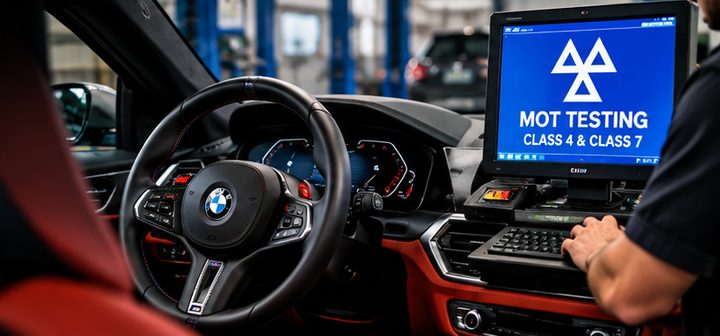
A scan is the first step in finding a fault, not the last. It lets a technician see which faults your car's control units have recorded and what the sensors were reporting at the time. It is quick and very useful, but it cannot see a worn part, a cracked hose or a corroded connector with its own eyes.
Understanding the limits of a scan helps you judge what you are paying for and avoids the frustration of a part being replaced that turns out not to be the problem. This article sets out what a scan reveals, what it does not, and what testing follows it.
What does a diagnostic scan actually show?
When diagnostic equipment is connected to the car's diagnostic socket, it communicates with the engine control unit and, depending on the vehicle, other modules such as those for the brakes, airbags, gearbox and body electrics. It lists any stored fault codes, along with whether each fault is current, pending or historic.
It can also show live data: coolant temperature, sensor voltages, engine speed, fuel trim and more. Many fault codes are accompanied by a freeze frame, which is a snapshot of conditions when the fault was logged. That context can be as valuable as the code itself.
- Stored, pending and historic fault codes
- Live sensor readings while the engine runs
- Freeze frame data from the moment of the fault
- Whether the car's emissions self-checks have completed
- Warning light information on supported systems
Does a fault code tell me which part is broken?
Usually not directly. A code such as an oxygen sensor circuit fault means the control unit saw a signal outside the expected range. The sensor may have failed, but the wiring, a connector, an exhaust leak or an engine problem upstream could produce the same reading.
This is why experienced technicians treat a code as a pointer. They follow it with practical tests, for example checking a signal on the wiring, inspecting a hose for leaks or measuring a component against expected values, before recommending a repair.
What can a scan not detect?
A scan only reports what the car's computers are able to monitor. Mechanical wear, such as a noisy wheel bearing, a worn clutch, a tired suspension bush or a leaking gasket, often triggers no code at all, though the effects may eventually show up in sensor data.
It also cannot find a fault that the car has not yet noticed, or one that comes and goes. Cheap code readers add a further limit, because they often cannot reach every module or read manufacturer-specific codes.
What happens after the scan at a garage?
After reading the codes, the technician interprets them against your description of the symptoms. Questions such as when it happens, whether it is worse cold or warm, and whether anything was done to the car recently all narrow the search.
At Automaster, a garage at Longcombe Cross near Totnes, we aim to explain what the evidence shows and what is still a possibility, then give you a quote for the repair we recommend. Diagnostic time depends on how obvious the fault is and how much of the car has to be reached, and we cannot promise that a repair is possible until we have inspected the vehicle.
Should I clear the codes after a scan?
Clearing codes without fixing the cause rarely helps. The light will usually return, and you may lose stored information that helps trace an intermittent fault. Clearing also resets the car's readiness checks, which can stop it passing the emissions part of an MOT until it has been driven enough for them to complete.
If you have a code reader at home, note the codes down before clearing anything, and share them with whoever looks at the car.
A scan is a quick way to see what the car has recorded, and real diagnosis is what you do with that information. To book a check, ask Automaster for a quote or call the quote line.
Common questions
Can I use a cheap code reader instead of a garage scan?
A basic reader can give you the main engine codes, which is a helpful start. It often cannot read other modules or live data in depth, and the code alone still needs interpreting, so a garage check usually goes further.
Why was a part replaced and the light came back?
The code may have pointed to a circuit rather than the part, so the real cause was elsewhere. Testing before replacing parts reduces this risk.
Will a scan find problems with my brakes or suspension?
It can read warning lights and sensors on systems such as anti-lock brakes, but worn pads, discs or suspension components are normally found by physical inspection, not by a scan.
What should I tell the garage before a scan?
Describe the symptoms, when they started, whether warning lights are on and any recent work done on the car. This helps focus the testing and saves time.
More advice
Ask for a quote
Tell us the make, model, registration and what the car is doing, and we will come back to you. Prefer to talk? Call our quote line on 01803 862152.
Automaster, Longcombe Cross, Longcombe, Totnes TQ9 6PL, United Kingdom