

How does the MOT emissions test work for petrol and diesel cars?
The MOT emissions test measures what comes out of the exhaust, using a gas analyser for petrol cars and a smoke meter for diesels.
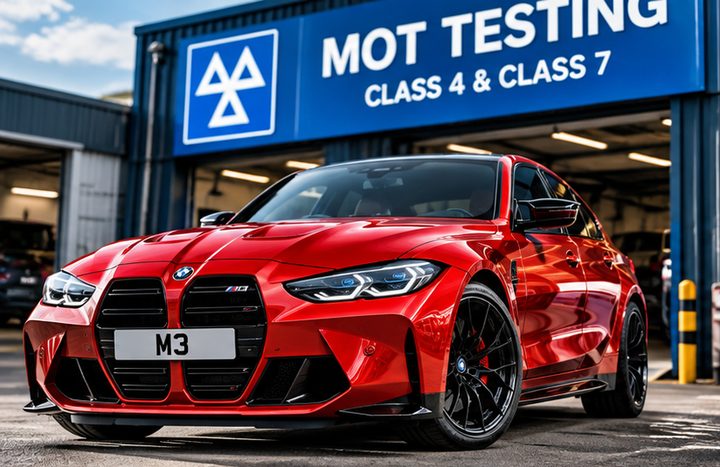
Petrol and diesel engines are tested differently because they produce different pollutants. A petrol car is checked for gases such as carbon monoxide and hydrocarbons, while a diesel is judged on how much visible smoke it produces under a short burst of acceleration.
In both cases the tester also looks at the exhaust system itself and at the dashboard warning lights. Here is what happens during the test, the usual reasons for a fail and how a garage deals with them.
What happens in a petrol car emissions test?
With the engine warm, a probe from a gas analyser is placed in the tailpipe. The tester takes readings at a raised idle speed and at normal idle, and the results are compared with limits that depend on the vehicle, usually its age and the type of engine management fitted. On cars with a catalytic converter, the reading that shows how well the engine is controlling the fuel mixture matters as well.
The engine must be properly warmed up and in sound condition for a fair reading, so a car with an obvious fault, such as a misfire, is likely to struggle.
How is a diesel emissions test different?
For a diesel, the engine is run up to its governed speed several times in succession, with the tester measuring the density of the exhaust smoke with a meter. The readings are compared against the limit set for that vehicle, which is often shown on a plate in the engine bay or found from the manufacturer data. Visible dense smoke at any stage can be a fail by itself.
Modern diesels with a particulate filter are also checked to make sure the filter has not been removed or tampered with. A filter that has been cut out or hollowed is a fail.
Why did my car fail its emissions test?
Causes differ between fuel types, and a few are shared. The engine management light being on also leads to a fail on its own. Typical reasons include:
- A worn or faulty catalytic converter on a petrol car
- A failing lambda or oxygen sensor
- Ignition faults, such as worn spark plugs or coils
- Blocked or worn injectors, or a clogged air filter
- A blocked or damaged particulate filter on a diesel
- An exhaust leak ahead of the sensors
What can I do before the MOT to help it pass?
A car in regular service condition is more likely to pass, because a clean air filter, fresh oil and sound spark plugs or injectors all help the engine burn fuel properly. Check that no warning lights are showing. Before the test, drive the car for a decent spell so that the engine and exhaust reach working temperature. Short, cold trips leave the engine less ready to give a fair reading.
On a diesel, if a warning about the particulate filter appears, follow your handbook. A longer drive at steady speed may help on some vehicles, though it depends on the car and is not a cure for every problem.
What does a garage do if the emissions test is failed?
We start by finding out why. That usually means reading fault codes, checking the ignition and fuel systems, inspecting the exhaust for leaks and looking at the sensors. Cost depends on the cause, since a spark plug is a different job from a catalytic converter, and parts and access also play a part. We explain our findings and you can ask for a quote before agreeing to anything.
Automaster, a garage at Longcombe Cross near Totnes, covers MOT testing together with exhausts, emissions and diagnostics, so the investigation and the repair can be handled in one place. Repairs are confirmed after inspection.
Keep the engine in good health, avoid warning lights and warm the car up before the test. If you want advice or a quote on emissions faults, ask Automaster.
Book online
Choose a service and book your visit online.
Common questions
Is the emissions test the same for every petrol car?
No. The limits depend on the vehicle, mainly its age and engine management. Your handbook or the testing database holds the details for your car.
Can a diesel pass with a bit of smoke?
A little is normal, but dense smoke can fail. The measured density is compared against the limit for the vehicle.
Will an engine additive help me pass?
Additives are not a substitute for fixing a fault. If a component is worn or failing, it needs diagnosing and repairing.
Is an exhaust leak an MOT problem?
Yes. A leak can affect emissions readings and is also tested for noise and security of the system, so it can lead to a fail.
More advice
Ask for a quote
Tell us the make, model, registration and what the car is doing, and we will come back to you. Prefer to talk? Call our quote line on 01803 862152.
Automaster, Longcombe Cross, Longcombe, Totnes TQ9 6PL, United Kingdom