

What is checked in an MOT test?
An MOT is a road-safety and emissions check of the parts that matter most when you drive, not a check of how well the engine or clutch is running.
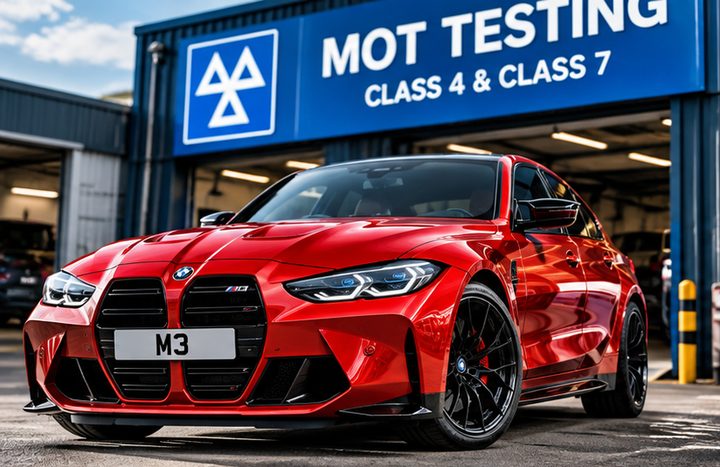
An MOT test looks at the safety-related parts of your car, plus its exhaust emissions. That means lights, brakes, steering, suspension, tyres and wheels, seatbelts, the body structure, your view of the road, the horn, the number plate and the exhaust. The tester works through a set list of items and records each one as a pass, an advisory or a defect.
It is a snapshot of the car on the day, not a promise about how long any part will last. Below we explain each area in turn, what you can glance at yourself and what happens if something fails. We are Automaster, a garage at Longcombe Cross near Totnes, and we carry out MOT testing for cars and vans.
Which parts of the car does an MOT test cover?
The test is split into areas rather than a single drive around the block. The tester inspects the vehicle on the ground, from underneath on a lift or in a pit, and under the bonnet, and the car is also checked on a brake roller or plate tester.
In broad terms the test covers the following areas. The exact items depend on the age and type of vehicle, so treat this as a guide rather than a full checklist.
- Lights, indicators, reflectors and the number plate
- Brakes, including the handbrake and brake fluid condition
- Steering, suspension, wheels and tyres
- Seatbelts, seats, doors and the horn
- Exhaust, fuel system and emissions
Are lights, brakes and tyres tested at an MOT?
Yes, and these are the areas where most of the work is done. Every exterior bulb is checked for operation, colour, aim and condition, including brake lights and indicators. The brakes are tested for how well they stop the car and how evenly they work across each axle, and the tester also looks at pipes, hoses, discs and pads where they can be seen.
Tyres must be a legal type for the vehicle, in sound condition with no cuts or bulges, and have at least 1.6 mm of tread across the central three-quarters of the tyre. Wheels are checked for damage and for secure fixings.
What about steering, suspension and the body of the car?
Steering is checked for excessive play, worn joints and leaks from the power steering system. Suspension parts such as springs, shock absorbers, bushes and ball joints are looked at for wear, damage and leaks.
The tester also checks the structure for corrosion or damage in areas that carry load, such as around suspension mounting points and the sills. Cosmetic rust on a panel is not the concern. Rust that weakens something important is. Doors must open and close securely, and the bonnet and boot must latch properly.
What does the MOT check for emissions and visibility?
The exhaust is checked for security, leaks and excessive noise, and the tailpipe emissions are measured. Petrol cars are tested against limits for pollutants. Diesel cars are checked for visible smoke, and the tester will also look to see that a diesel particulate filter is still fitted if the car left the factory with one.
For visibility, the windscreen is checked for damage in the driver's view, the wipers and washers must work, and mirrors must be secure and usable. Dashboard warning lights are also looked at. A lit engine management, ABS or airbag warning can lead to a defect being recorded.
What is not checked in an MOT, and what happens if something fails?
An MOT does not assess the condition of the engine, clutch or gearbox, so a car can pass while still needing mechanical work. It is also not a service. Oil levels, filters and general wear on drive components are outside the test, which is why many drivers book a service as well.
If an item is recorded as a dangerous defect, the car should not be driven until it is repaired. Major defects mean a fail, and minor defects and advisories are noted but do not fail the car. After a fail, rules on retesting depend on where the repairs are carried out and how quickly, so ask us about your options when you collect the result.
The MOT is a focused safety and emissions inspection, so knowing what it covers helps you spot problems before test day. If you would like your car tested at our garage near Totnes, ask us for a quote.
Book online
Choose a service and book your visit online.
Common questions
Does an MOT test the engine and gearbox?
No. The MOT looks at safety and emissions, not the mechanical condition of the engine, clutch or gearbox. Warning lights and visible leaks can still be recorded, so a fault may show up indirectly.
Is the interior checked at an MOT?
Only the safety-related parts. The tester checks seatbelts and their mountings, the driver's seat, the horn, the mirrors, and warning lights on the dashboard. Trim, upholstery and the stereo are not part of the test.
Will a warning light on the dashboard fail my MOT?
It can. Warning lights for the engine management system, ABS, airbags or power steering are checked, and a lit warning may be recorded as a defect. It depends on the vehicle and which light is showing.
How often does a car need an MOT?
A car needs its first MOT on the third anniversary of its registration and then every year after that. You can usually have it tested up to a month before the expiry date without losing the renewal date.
More advice
Ask for a quote
Tell us the make, model, registration and what the car is doing, and we will come back to you. Prefer to talk? Call our quote line on 01803 862152.
Automaster, Longcombe Cross, Longcombe, Totnes TQ9 6PL, United Kingdom