

Tyre tread depth and the legal limit
The legal minimum tread depth for a car tyre in the UK is 1.6 mm, but tyres grip noticeably less well before they get that low.
The legal minimum for car tyres in the UK is 1.6 mm of tread across the central three-quarters of the tyre, around its entire circumference. Below that, the tyre is illegal and the car would fail an MOT on that point.
That figure is a legal floor, not a recommendation. Shallow tread clears less water, so stopping distances in the wet grow long before the tyre reaches the limit. Many drivers choose to replace tyres once they are getting close to the 3 mm mark.
What is the legal tyre tread depth in the UK?
The 1.6 mm rule applies to every tyre on a car, including the spare if you intend to use it on the road. The depth is measured in the main grooves across the central three-quarters of the tread, not just at the very edge or just on the middle rib.
Penalties for driving on illegal tyres apply per tyre, and your insurer may also take a dim view if a crash involves a bald tyre. Rather than trusting a rule of thumb, it is worth checking each tyre separately, because front and rear tyres often wear at different rates.
How do I check my tyre tread depth at home?
A tread depth gauge is cheap and accurate, and many drivers keep one in the glovebox. Push the probe into a main groove, read the number, and repeat at several points across the tyre and around the wheel.
If you do not have a gauge, look for the tread wear indicators, small raised bars moulded into the base of the main grooves. When the surface of the tread is level with those bars, the tyre is at or very near the legal limit. The coin trick is less precise than a gauge, so treat it as a rough guide only.
- Check all four tyres, not just the front pair
- Measure in the outer, middle and inner grooves
- Look for uneven wear, which can point to alignment or pressure problems
- Check the sidewalls for cuts, bulges and cracking while you are there
Why replace tyres before they reach 1.6 mm?
Water has to escape from under the tyre, and the grooves do that job. As they get shallower, the tyre is more likely to aquaplane and the car takes longer to stop on a wet road. Worn tyres also cope less well with standing water and slush.
Summer and winter matter too. A tyre that is acceptable on a dry July day can feel uncertain on a wet November morning, so many drivers set their own replacement point above the legal limit. Your tyre fitter can tell you where your particular tyres stand.
What does a garage do when I ask about my tyres?
We check the tread depth across each tyre, look for damage, uneven wear and signs of age, and confirm that the tyre size, load rating and speed rating match what your vehicle needs. If the wear pattern looks unusual, we will say so, because it can mean the wheels need aligning or that pressures have been wrong for a while.
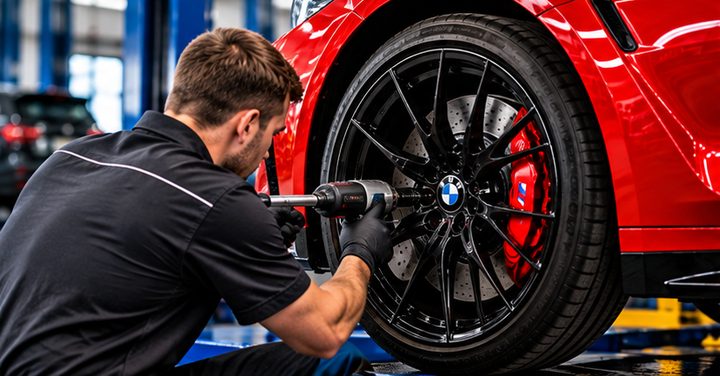
Fitting new tyres involves removing the wheel, fitting and inflating the new tyre and balancing the wheel before it goes back on. What affects the cost is the tyre size, the type of tyre you choose and whether anything else needs attention, so the sensible way to find out is to ask for a quote.
When should I stop driving on worn tyres?
Stop and get the tyre looked at straight away if you can see cords or fabric through the rubber, a bulge in the sidewall, a deep cut, or tread that has split. Those are safety problems regardless of the depth reading.
If a tyre is at or below 1.6 mm, it should not be driven on the road at all, so arrange a replacement rather than waiting for the next service. Automaster is a garage at Longcombe Cross near Totnes, and you are welcome to ask us to check your tyres and give you a quote.
The legal limit is 1.6 mm, but earlier replacement keeps wet grip in hand. Ask us for a tyre check and a quote if you are unsure where yours stand.
Common questions
Is 1.6 mm really the legal limit in the UK?
Yes, for cars it is 1.6 mm across the central three-quarters of the tread and around the whole circumference. Vans and other vehicles can have different rules, so check the rules for your vehicle type.
Is 3 mm tread safe?
It is above the legal limit, but wet grip and stopping distances are already reduced compared with a new tyre. Many drivers plan replacement around this point rather than waiting for the limit.
Will worn tyres fail an MOT?
A tyre below the legal minimum will fail, as will one with serious damage such as exposed cords or a large bulge. The tester assesses the condition on the day.
Should I replace tyres in pairs?
It often makes sense to fit new tyres on the same axle together so grip is even side to side. Which axle gets the new pair depends on the vehicle, so ask when you request a quote.
More advice
Ask for a quote
Tell us the make, model, registration and what the car is doing, and we will come back to you. Prefer to talk? Call our quote line on 01803 862152.
Automaster, Longcombe Cross, Longcombe, Totnes TQ9 6PL, United Kingdom