

Why is my exhaust blowing or suddenly loud?
A sudden roar, rasp or ticking from the exhaust almost always means a leak, a failed joint or a corroded section letting gas escape before the silencer.
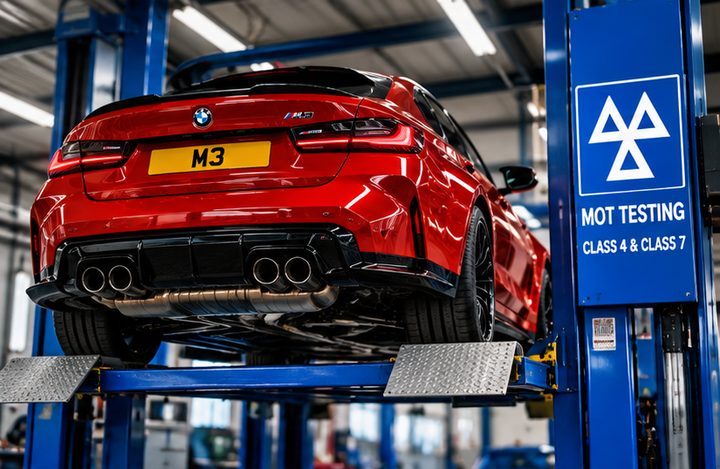
If your exhaust has become suddenly loud or sounds like it is blowing, there is almost certainly a leak somewhere along it. It might be a split in a pipe, a blown gasket at a joint, a failed flexible section or a rotted silencer box.
It is more than a noise problem. A leak can let exhaust gas reach the cabin, and a loose pipe can drop onto the road. Here is how to work out the cause and what to do next.
What makes an exhaust blow or sound louder?
Exhaust gas is meant to travel through sealed pipes and the silencer, which quiet the noise. Anywhere that seal breaks, the sound escapes early, and the car gets louder, usually most noticeably under acceleration.
Rust is the most common reason in a damp climate like the UK, especially where the pipe has been affected by road salt and short journeys that let moisture sit inside.
- A corroded or holed silencer box
- A blown gasket between pipe sections or at the manifold
- A cracked exhaust manifold
- A split in the flexible joint near the engine
- Broken or missing rubber hangers letting the system sag and crack
Is it safe to drive with a blowing exhaust?
Not if exhaust fumes are coming into the car. Carbon monoxide is a colourless, odourless gas and is dangerous. If you smell fumes, feel drowsy or get headaches while driving, open the windows, stop somewhere safe and do not carry on.
Even without fumes, a dangling pipe can detach, and a leak near the engine can damage nearby parts through heat. Have it looked at promptly.
What can I check without taking anything apart?
With the engine off and the exhaust completely cool, look for hanging pipes, visible holes, heavy rust and soot staining around joints. Black marks near a joint often show where gas is escaping.
Listen for where the noise comes from: a rasp from the front points to the manifold or first joint, while a roar from the rear suggests the silencer. Never run your hand along a hot exhaust, and do not work under the car without proper support.
How will a garage fix a loud exhaust?
We put the car on a lift, inspect the whole system and find the leak. Sometimes a gasket or clamp is enough. In other cases a section or the silencer needs replacing, and a cracked manifold is a bigger job.
Cost depends on which part has failed, whether it is available for your vehicle and whether bolts have seized from corrosion. We cannot say what is possible until the car has been inspected, so ask for a quote and describe the noise.
Why do exhausts keep failing in the same place?
Joints and flexible sections take the most strain, because the engine rocks on its mounts and the system expands and contracts with every heat cycle. A worn engine mount or a broken hanger can put extra stress on one spot, so a repair that ignores it may not last.
Short journeys also matter. Condensation forms inside the pipe and silencer and does not always burn off, so the metal rusts from the inside. When we inspect an exhaust we look at the mounts and hangers as well as the leak, so the repair has a better chance of lasting. Whether that is needed depends on the vehicle, and we can only tell once we have seen it.
A loud or blowing exhaust is a leak that will not mend by itself, and fumes in the cabin make it a safety issue. Automaster at Longcombe Cross near Totnes can inspect it, so ask for a quote.
Common questions
Will a loud exhaust fail the MOT?
It can. The MOT checks that the exhaust is secure, free from leaks and not excessively noisy, so a blowing system is likely to cause a failure.
Why is the noise worse when the engine is cold?
Metal expands as it warms and can close a small gap, so a leak is often loudest on a cold start. That does not mean it is harmless, as it usually gets worse over time.
Can a temporary repair paste do the job?
It can sometimes seal a small hole for a short while, but it is not a lasting fix for a failing joint or rotten section. Have it inspected.
What should I tell you when I ask for a quote?
Tell us the make, model and year, where the noise seems to come from and when it is loudest. Photos of any visible damage can also help.
More advice
Ask for a quote
Tell us the make, model, registration and what the car is doing, and we will come back to you. Prefer to talk? Call our quote line on 01803 862152.
Automaster, Longcombe Cross, Longcombe, Totnes TQ9 6PL, United Kingdom