

Is My Clutch Bite Point Too High or Too Low?
The bite point is where the clutch starts to grip as you lift the pedal, and a change in it usually means wear or a hydraulic fault.
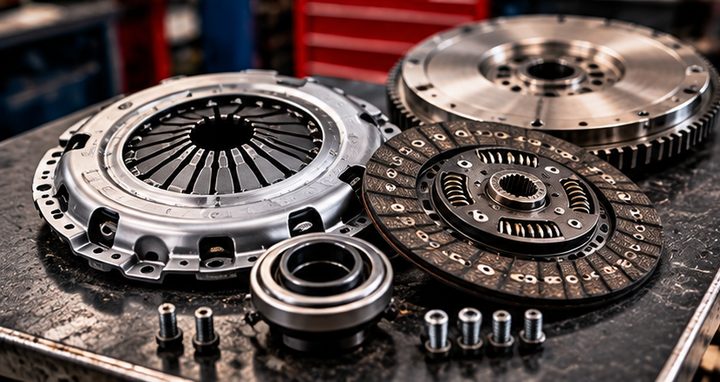
Press the pedal and lift it slowly: the point where the engine note changes and the car starts to move is the bite point. On a healthy clutch it sits roughly mid-travel and stays put from day to day.
If it has moved up near the top of the pedal travel, or down towards the floor, something has changed. High and low bite points point to different problems, so here is how to tell them apart.
What does a high bite point mean?
A high bite point means the clutch only grips right at the top of the pedal travel. The most common reason is a clutch plate that has worn thin, so the clamping point moves. It can also mean the pedal or release system is out of adjustment.
A worn clutch often comes with slipping, where the revs rise but the car does not accelerate as expected, especially in higher gears or going uphill.
What causes a low bite point or a pedal that goes to the floor?
When the bite point is low, you press a long way down before the clutch fully releases. Common causes are air in a hydraulic system, a failing master or slave cylinder, a stretched or badly adjusted cable, or a worn release mechanism.
In some cases the pedal feels soft and drops slowly, which points to a hydraulic leak. That is one to take seriously, because the clutch may stop releasing altogether.
Can I adjust the bite point myself?
Some older cars have a cable with an adjuster, and your handbook will say if yours is adjustable. Many modern cars have hydraulic clutches that are self-adjusting and cannot be set by hand.
Do not try to adjust anything you are unsure about. An incorrect setting can stop the clutch releasing or cause it to slip, and neither is safe. If you are unsure, it is far better to leave it alone and ask a garage to look at it.
- Check your handbook for adjustment guidance
- Look at fluid level if the clutch is hydraulic
- Note whether the bite point changed suddenly or gradually
- Tell the garage how long it has been happening
How does a garage diagnose a bite point problem?
A sudden change tends to point to hydraulics, while a gradual rise in bite point suggests wear.
If the clutch is worn, replacement is normally the answer, with the flywheel and surrounding parts checked at the same time. If it is hydraulic, the faulty cylinder is replaced and the system bled. The cost depends on the vehicle and cause, and we cannot say more until the car is inspected.
When should I stop driving?
Stop if the clutch slips badly, the pedal sinks to the floor, or you cannot get into gear. These problems can leave you unable to control the car at a junction or on a hill.
A gradually rising bite point with no slipping can usually be driven for a short time to a garage, but it will only get worse, and continued driving can damage the flywheel. Heat from a slipping clutch can mark the flywheel face, which turns a straightforward clutch job into a larger one.
A bite point that has moved is an early warning worth acting on. Automaster is a garage at Longcombe Cross near Totnes in South Devon; ask us for a quote or call the quote line and tell us how the pedal feels.
Common questions
Where should a clutch bite point be?
It varies by vehicle, but it is usually somewhere in the middle of pedal travel and consistent. Check your handbook if unsure.
Does a high bite point always mean a worn clutch?
No. Wear is a common cause but adjustment and release system faults can also move it, so inspection is needed.
Why did my bite point change suddenly?
A sudden change often points to a hydraulic leak, a failed cylinder or a cable fault rather than gradual wear.
Can a low bite point be fixed without a new clutch?
Sometimes, if the fault is air, a cylinder or adjustment. A garage must check to know.
More advice
Ask for a quote
Tell us the make, model, registration and what the car is doing, and we will come back to you. Prefer to talk? Call our quote line on 01803 862152.
Automaster, Longcombe Cross, Longcombe, Totnes TQ9 6PL, United Kingdom